
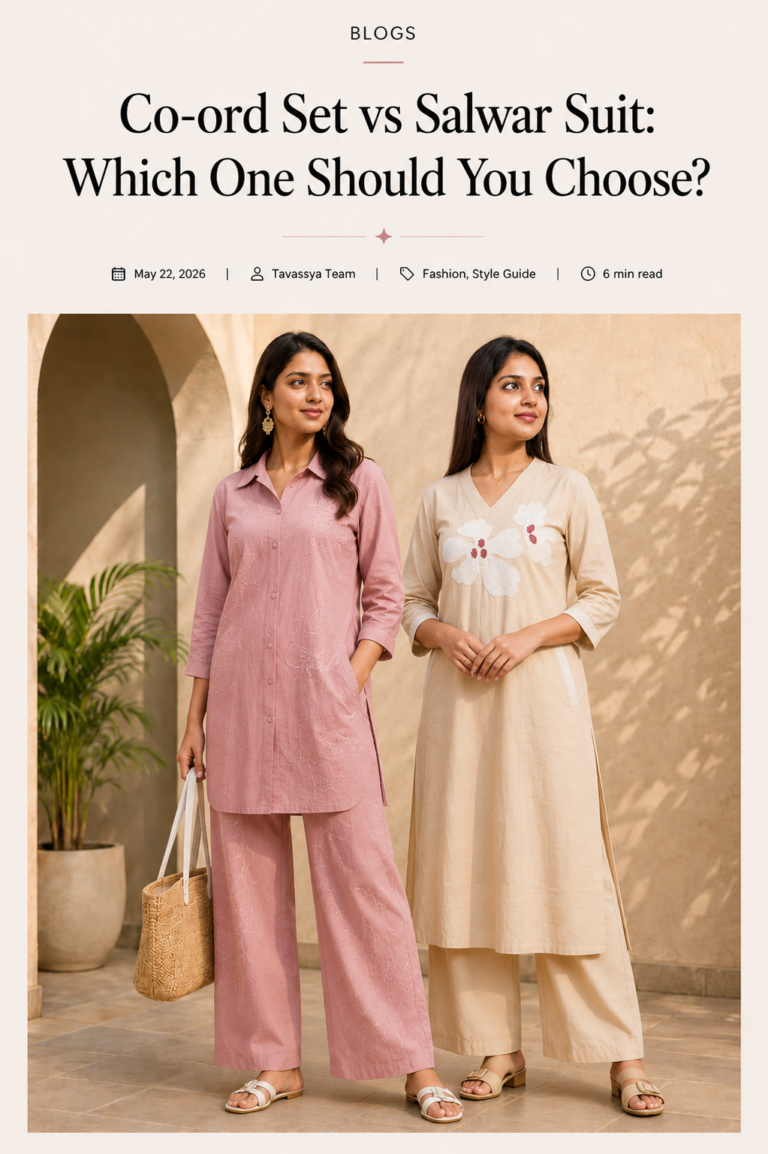
Co-ord Set vs Salwar Suit: Which One Should You Choose?
Standing in front of your wardrobe (or a shopping cart) trying to decide between a co-ord set and a salwar suit is a familiar dilemma for most women who love Indian ethnic and fusion wear. Both are comfortable, both are versatile, and both can be dressed up or down. So how do you decide which one to add to your wardrobe — or which one to wear on a given day? This guide breaks down the real differences so you can choose with confidence.
Understanding the Basics
A co-ord set is a two-piece outfit — usually a top and bottom made from matching or coordinated fabric — designed to be worn together as a single, pre-styled look. A salwar suit is traditionally a three-piece outfit consisting of a kameez, a salwar or pants, and a dupatta. The extra layer of the dupatta is what gives the salwar suit its distinctly traditional character, while the co-ord set leans more contemporary and fuss-free.
Comfort and Ease of Wear
Co-ord sets generally have the edge when it comes to sheer ease of getting dressed. With no dupatta to manage or drape, you can put on a co-ord set and be ready to walk out the door in minutes. Salwar suits require a bit more attention — draping the dupatta, adjusting the fit — but many women find that this extra structure adds to the outfit’s polish, particularly for occasions where you want to look more put-together.
If you’re looking for grab-and-go comfort for busy weekdays, a co-ord set is usually the more practical pick. If you enjoy the ritual of styling and want an outfit that feels complete on its own, a salwar suit delivers that.
Styling Versatility
Both outfits are versatile, but in different ways. A co-ord set’s top and bottom can often be separated and mixed with other pieces in your wardrobe — the top with jeans, the bottom with a different blouse — giving you more mix-and-match potential over time. A salwar suit’s versatility comes from how you style the dupatta and accessorise; the same three-piece set can look entirely different depending on the drape, footwear, and jewellery you choose.
Occasion Suitability
Here’s where the choice often becomes clearer, based on what’s on your calendar:
- Casual outings and daily errands — both work well, though co-ord sets are slightly quicker to style.
- Office days — a straight-cut salwar suit reads as more traditionally professional, while a solid-coloured co-ord set offers a modern, minimal alternative.
- Family functions and festive days — salwar suits, especially Anarkali styles, tend to feel more traditionally festive.
- Evening plans and get-togethers — co-ord sets in richer fabrics and jewel tones often feel more contemporary for evening settings.
- Wedding functions — both work depending on the specific function; salwar suits suit daytime rituals, while co-ord sets in silk blends work well for sangeet or reception-adjacent events.
Fabric and Fit Differences
Because a co-ord set is typically a fitted or semi-fitted top with a coordinated bottom, the fit tends to be more tailored to your body shape. A salwar suit’s kameez is generally cut looser and longer, which makes it a forgiving choice across a wider range of body types and more comfortable for extended wear. If you’re unsure about sizing, a salwar suit’s relaxed kameez silhouette is often the safer choice for a first-time purchase from a new brand.
Which One Works Better for Your Body Type
Both co-ord sets and salwar suits can be flattering on every body type when the fit and proportions are right — the key is choosing the correct style within each category rather than avoiding one entirely.
- If you prefer a more defined waistline, look for co-ord sets with a fitted top and a straight or flared bottom.
- If you prefer more coverage and a relaxed fit, an Anarkali or straight-cut salwar suit with a longer kameez works beautifully.
- For a leaner, elongated look, monochrome co-ord sets create a continuous vertical line.
Budget Considerations
Since a salwar suit includes three pieces, it can sometimes work out to be better value if you’re looking to build a complete outfit in one purchase, dupatta included. Co-ord sets, being two pieces, are often priced slightly lower and can also double up as separates later, effectively extending their cost-per-wear over time.
Can You Own Both? Absolutely.
The honest answer for most women is that this isn’t really an either-or decision — it’s about building a wardrobe with both. Co-ord sets are excellent for quick, low-effort styling on busy days, while salwar suits are ideal for occasions where you want the added grace of a dupatta and a more traditional silhouette. A well-rounded ethnic wardrobe usually includes a mix of both, chosen based on fabric, colour, and how each piece fits your lifestyle.
Final Verdict: It Depends on the Day
There’s no universal winner between a co-ord set and a salwar suit — the right choice depends on your occasion, your comfort preference, and how much time you want to spend styling. Busy weekday? Reach for a co-ord set. Festive family function? A salwar suit will likely feel more complete. The good news is that you don’t have to choose just one.
At Tavassya, we design both co-ord sets and salwar sets with the same commitment to soft, true-to-size fabrics and thoughtful fit, so whichever you reach for, you know it’ll work for you. Browse our collections and build a wardrobe that has an answer ready for every occasion.